

Mirror Reflections: Beauty Rituals and Community
by Rachel DuBose and Jenni Lamb
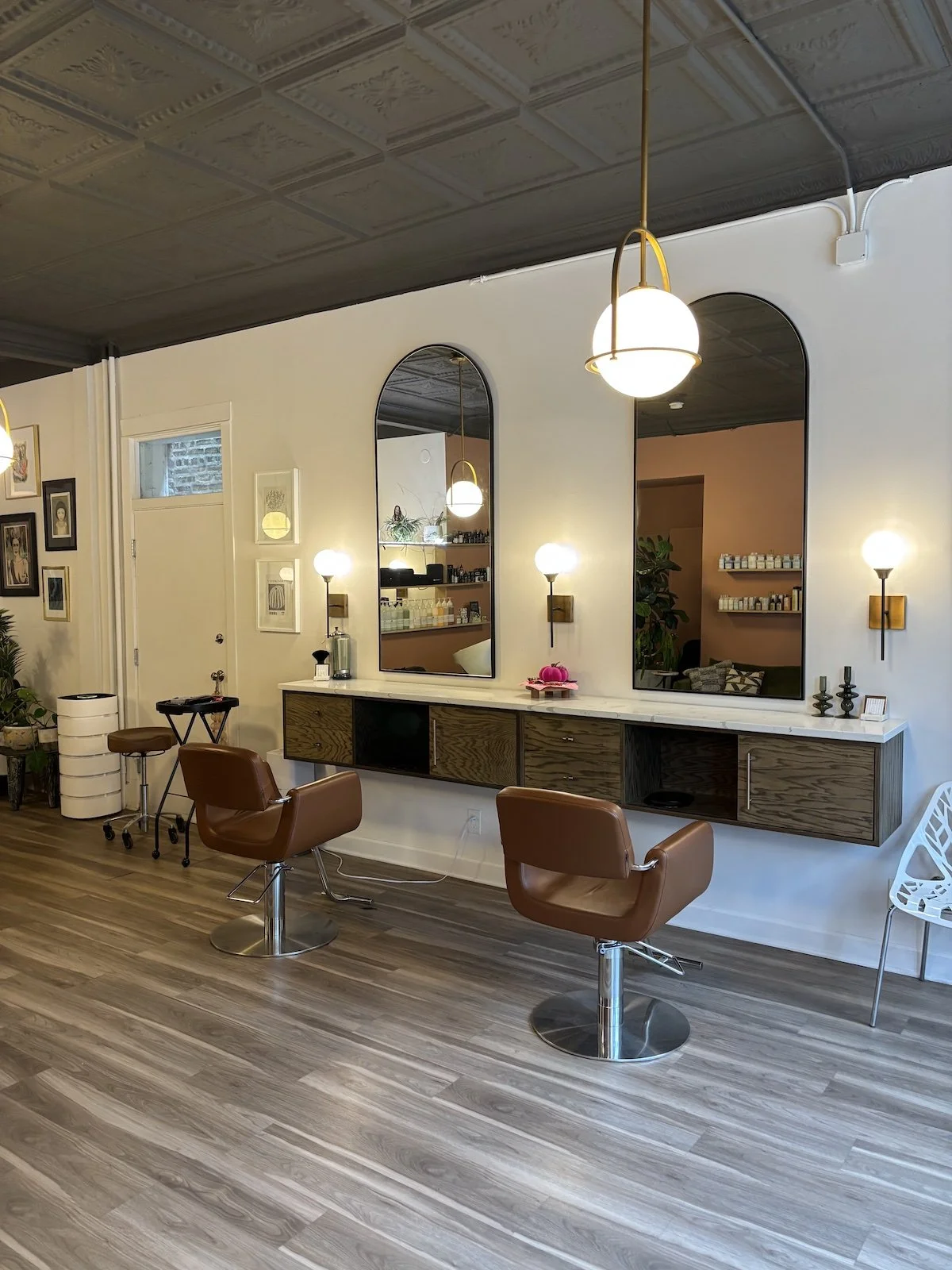
The Beauty Project has been in the works since 2019, when the lovely director Erin Murray sent along an article about the high cost of beauty and why some are willing to participate and go broke in pursuit of beauty standards. This led to a fun workshop where writers created and shared short pieces that took place in a salon and explored this theme. This fun workshop was immediately followed by the not-so-fun events of 2020. But the topic was rich, and we continued to dream about fully realizing the idea in Chicago.
In 2024, we received a grant to connect with beauty professionals and bring on a cohort of writers, including Kirsten Baity and Kylie Ramirez. Each writer was paired with a beauty professional to create a piece that spoke to a particular beauty practice or self-care ritual specific to their identity. Although we started in a beauty salon, it became clear through discussions that these rituals often went beyond the salon. Creating pieces about beauty meant that we had to look beyond a physical space, and draw from our identities, hearts, and lived experiences…even back to our childhood homes in some cases.
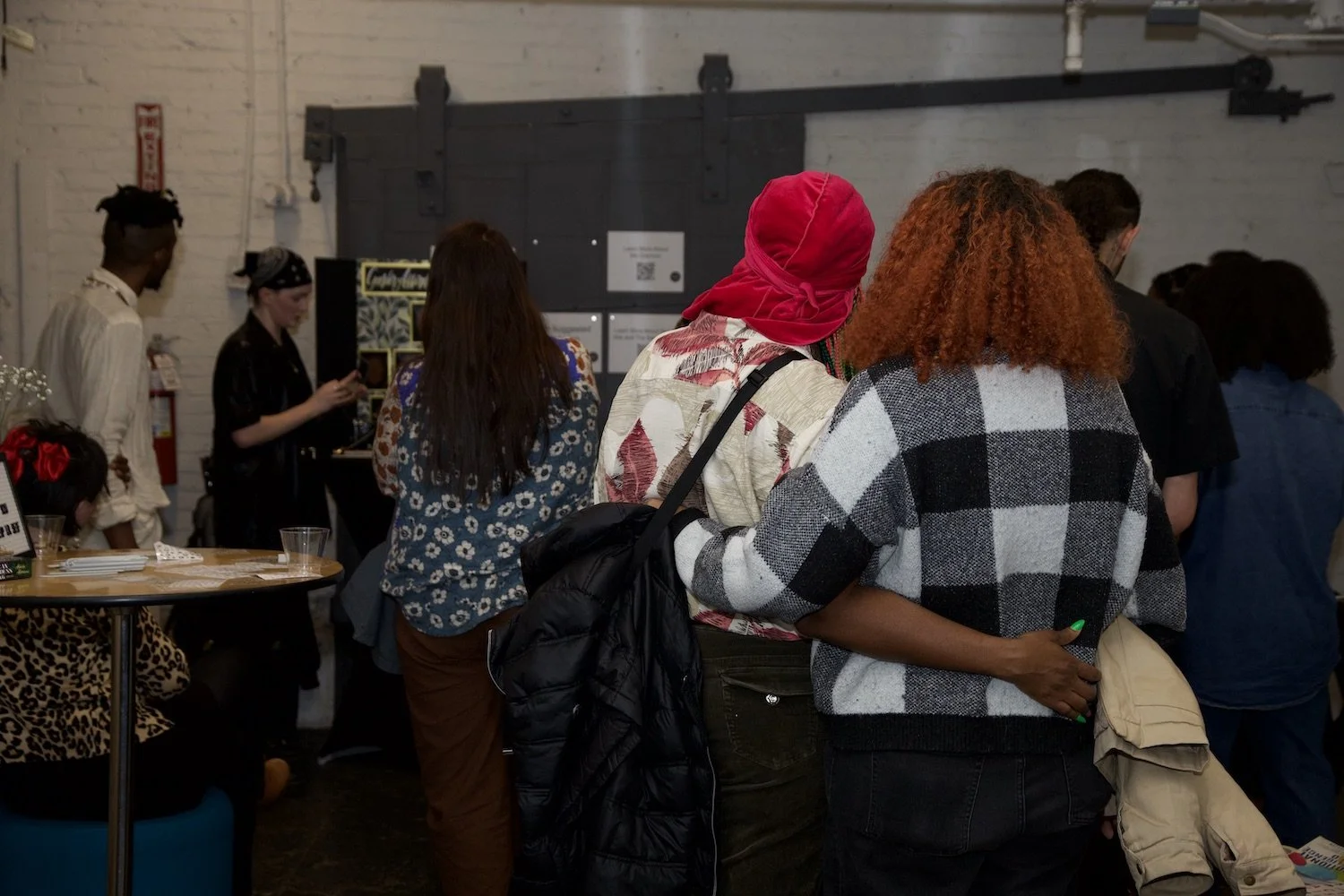
In May 2025, we invited audience members to The Salon Project: a workshop performance (directed by the incredible Kezia Waters) that took place at Fulton Street Collective. Audiences were led through an affirmation prompt, beauty demos, and four short plays. Our Beauty and Fitness collaborators: Mo Drennon, Antje Kastner, Olivia Hatch and Jamie Marshall (Love U Collective), and Val Sanchez led the audience through interactive demos. This performance, rather than focusing on a single narrative, was able to tell a story through multiple lenses where audience members could both feel seen, and gain understanding from the stories of others.
In spring of 2026, we’re planning a full production: three performances over the course of one week in Ravenswood and Bronzeville in Chicago. When we began pre-pandemic, we didn’t anticipate how many communities might be part of this conversation. These seemingly smaller issues of outward beauty speak to the big issues of our identities, belonging, and quality of life. This piece wants to be part of more than one space, a first for our collective.
Below are the questions we discussed among our collaborators in 2024, to create pieces for The Beauty Project:
What is one of your beauty rituals? Did you learn this or create it yourself?
Jenni: Every night, I take one of those circular cotton pads and wet it with water to remove the dirt or makeup I wore through the day. Then I apply moisturizer to my face before I go to bed. It’s a way to say goodbye to the day and also look myself in the eye every night. (And some nights, my cat licks the lotion off of my face as a bonus treatment.) Raising a kid and trying to make something of myself can be a lot at times, and lotion has become a simple way to decompress. I don’t have a ton of products, but I do make sure to get the good stuff from my local favorite store: Merz Apothecary.
Rachel: I think my biggest consistent beauty ritual would be my hair. I have a very thorough step-by-step process. When I was little, my mother would wash and dry my hair on Sundays, and it was a production. After church, she would sit me in the kitchen and wash and roll it, and then put me under the dryer. She’d give me snacks and let me watch movies, but of course, I would peek my head out every 20 minutes asking if we were dry. I had very thick hair as a kid. I feel like the whole process took about 2-3 hours, but felt like it was forever. So now, when I wash, condition, deep condition, detangle, put a leave-in conditioner, and then mousse and dry my hair, I can get that process down to 2 hours, and it’s therapeutic. I listen to music, I watch a movie. I just wash all of the thoughts out of my hair.
“I listen to music, I watch a movie. I just wash all of the thoughts out of my hair.”
What are your memories of watching your mother or caregiver get ready?
Jenni: Mom was big on the curling iron, and you always had to be careful around it. It would sit on the bathroom counter, and if the little dot was red, it was not to be touched. I’d watch her carefully section her hair and let the iron do its work until she achieved that Farrah Fawcett look: soft, framed, feathered hair around her very heart-shaped face. Then she’d sit me down and do the same to me. I liked how warm it felt, but my hair was thick and fine, and typically didn’t do what she’d hoped it would do.
Rachel: When I was younger, my mom was very particular about her appearance. Her hair and nails were always immaculate. But when it came to makeup, she would take a tube of lipstick and swipe it over her cheeks and then apply it to her lips, so her blush and lipstick were always matching. And then she did her nails. I would touch her nails and feel the smooth slickness and beg for her to paint mine. She would paint mine a soft pink. After a while, she stopped painting her nails because she was no longer in sales but started working more in the lab (she’s a food scientist), but she would let me paint my own, and I got a little crazy over it.
How do we disentangle beauty from the industry?
Jenni: What I’m most excited about with this project is that each writer brings their own definition that is outside of (and directly contrary to) how “beauty” is defined through social media. Another goal is to uplift small business owners and local products rather than products made by corporations. I love so many of the points that adrienne maree brown makes in her great book Emergent Strategy, where she explains how change on a small, grassroots scale directly impacts the way we operate on a bigger national and cultural scale. And so even though our audiences are intimate, we hope their experience impacts and reverberates through their communities.
Rachel: I feel like it’s human nature to compare ourselves to one another, but I don’t think we can actually disentangle ourselves from the “industry” because it’s always going to be there. I think beauty and commerce go hand in hand but I think we can redefine how we choose to interact with the industry by focusing on health versus trend, and appreciating our natural beauty more, and allowing the enhancements to enhance without fully altering our look.
We Want to Hear from You
Because we’re looking to help folks feel seen as part of this project, please feel free to submit your responses to any or all of these questions to secondsitechi@gmail.com. We’ll select a few to be included in a future post.

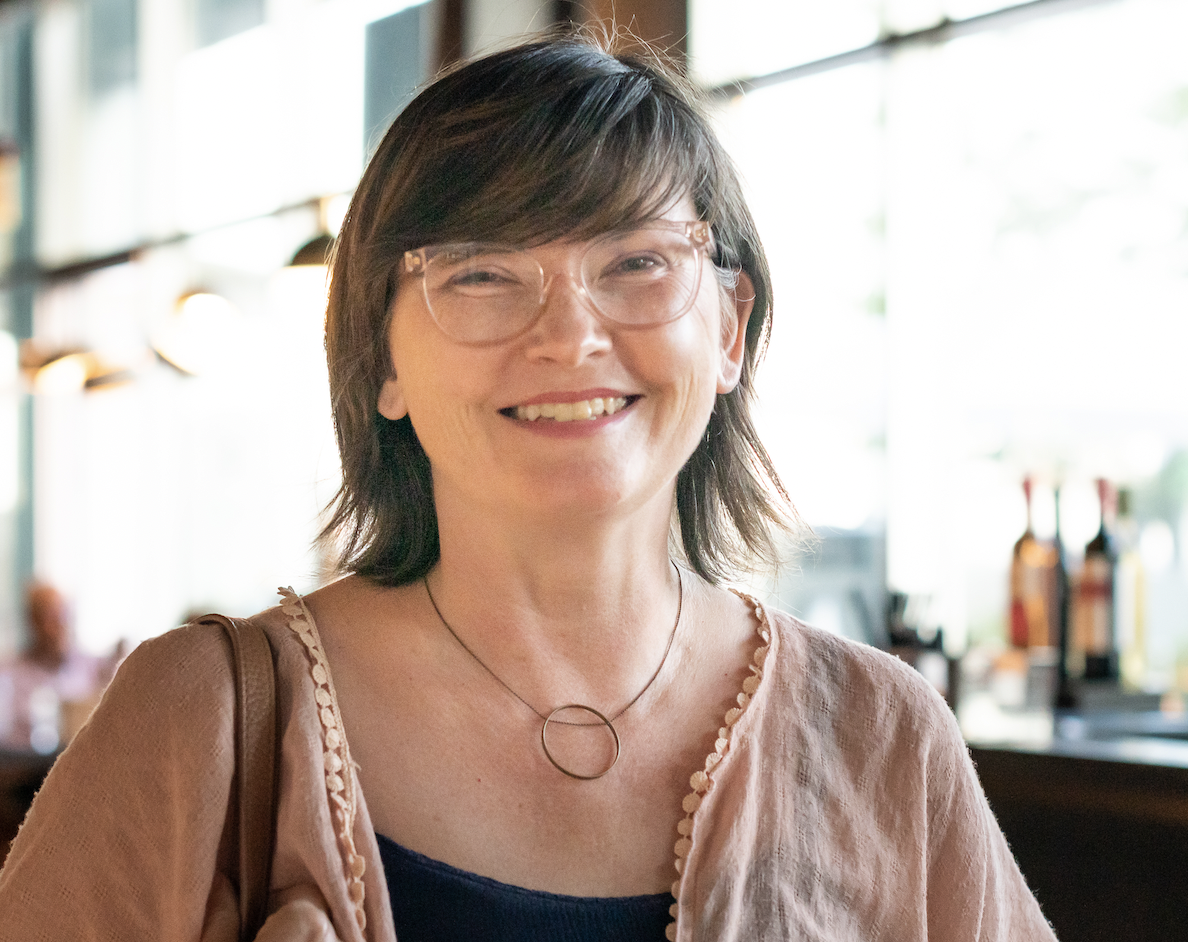
Rachel DuBose is a playwright, educator, and producer based in Chicago.
Jenni Lamb is a writer, producer, and mom of a teenager originally from the Detroit-area, currently living in Chicago.
Where to?
Continue exploring Site Lines